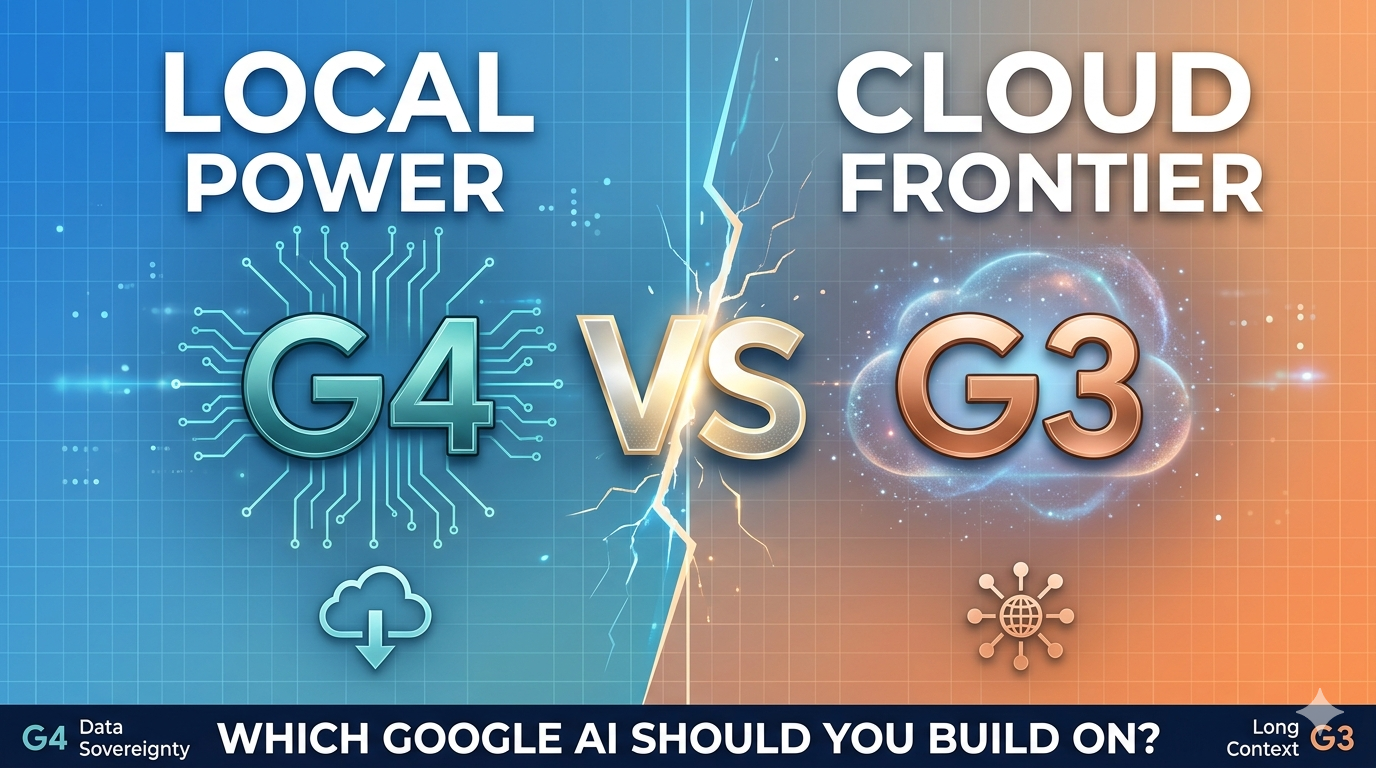

The lines between “open” and “closed” AI have never been thinner. With the recent release of Gemma 4, Google DeepMind has brought its frontier-level research—previously exclusive to the Gemini 3 cloud ecosystem—directly to the local developer’s machine.
But while both models share the same DNA, they are built for entirely different operational worlds. In this deep dive, we compare Gemma 4 vs Gemini 3 to help you decide where to deploy your next AI application.
1. The Core Philosophy: Open Weights vs. Managed Service
The most fundamental difference is how you access the intelligence:
- Gemma 4: A family of open-weight models under the Apache 2.0 license. You download the weights, run them on your hardware (private servers, workstations, or mobile), and have 100% data sovereignty.
- Gemini 3: A proprietary, managed API service. Google handles the infrastructure, scaling, and security. It offers “frontier+” performance but requires an internet connection and follows a per-token pricing model.
2. Technical Specifications & Performance
While Gemini 3 Pro remains the “smartest” model in Google’s stable for massive multi-modal reasoning, Gemma 4 has closed the gap significantly in logic and coding.
| Feature | Gemma 4 (31B Dense) | Gemini 3 (Pro) |
| Availability | Local / Open Weights | Cloud API Only |
| License | Apache 2.0 (Permissive) | Proprietary |
| Context Window | 256K Tokens | 1M+ Tokens |
| AIME 2026 (Math) | 89.2% | ~94% (Estimated) |
| Native Audio | Yes (E2B / E4B variants) | Yes (All tiers) |
| Privacy | 100% Local / Private | Managed Cloud Security |
3. The Architecture Shift: Hybrid Attention
One of the reasons Gemma 4 is outperforming older versions of Gemini is its Hybrid Attention mechanism. By alternating between local sliding-window attention and global attention, Gemma 4 manages a 256K context window with a fraction of the VRAM required by previous generations.
In contrast, Gemini 3 utilizes a more massive, compute-heavy architecture optimized for Google’s TPU (Tensor Processing Unit) clusters, allowing it to maintain a staggering 1-million-token context that Gemma 4 cannot yet match.
4. Multimodal Capabilities
- Gemma 4: Takes a “Mobile-First” approach to multimodality. The E2B and E4B models are the first open-weights to offer native audio-to-text and vision-to-text on-device.
- Gemini 3: Is a true “Omni” model. It doesn’t just understand audio and video; it can generate high-fidelity images (via Imagen 4 integration) and video snippets (via Veo 2), something the local Gemma 4 weights cannot do natively.
5. Benchmark Battle: Reasoning and Coding
In the Arena AI Leaderboard, Gemma 4 (31B) has shocked the industry by outperforming many cloud models from 2025.
“Gemma 4 isn’t just an incremental update; it’s a structural rewrite. On the LiveCodeBench v6, it achieved an 80% success rate, nearly matching the performance of the proprietary Gemini 3 Flash.”
However, for extremely complex, multi-document synthesis (like analyzing 2,000 pages of legal text), Gemini 3 still holds the crown due to its superior long-context retrieval (Needle In A Haystack) performance.
The Verdict: Which is right for you?
Choose Gemma 4 if:
- You require Data Sovereignty (e.g., Healthcare, Legal, Defense).
- You want to avoid API Latency and per-token costs.
- You are building Autonomous Agents that need to run offline on local hardware.
- You want to fine-tune the model on proprietary data using tools like Unsloth.
Choose Gemini 3 if:
- You need the absolute highest reasoning capability available.
- Your workflow requires 1-million-token context or massive document analysis.
- You need native Image or Video generation alongside text.
- You prefer a zero-maintenance, scalable cloud infrastructure.
Related Articles:
- How to fine-tune Gemma 4 using Unsloth
- Google Launches Gemma 4: The New King of Open-Weight AI Models
- Top 5 Local LLM GUI’s for 2026
- More tech blogs click here..